
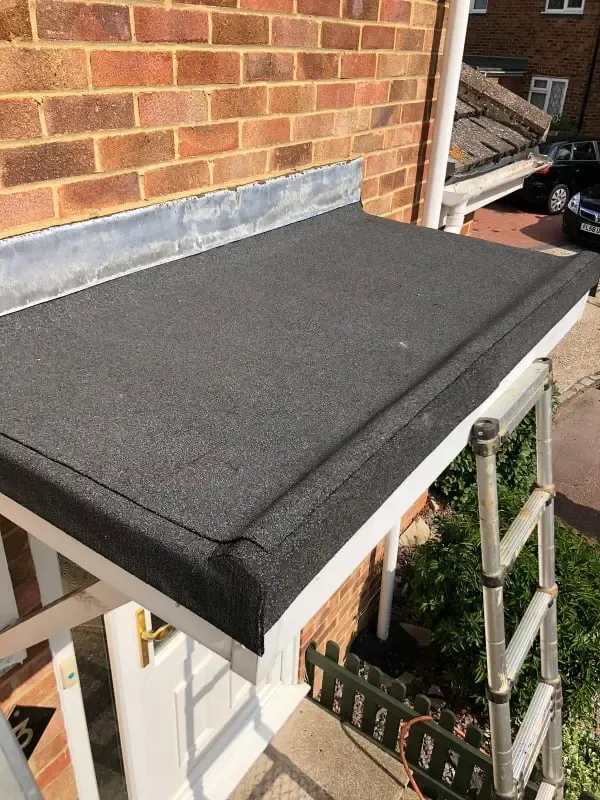
If you need a new flat roof on a garage, extension, dormer, or porch, the choice usually comes down to two systems: EPDM rubber or GRP fibreglass. Both are significant upgrades over the old felt roofs found on many Edinburgh properties, and both will last 25 to 30 years when installed correctly.
But they are not interchangeable. Each has strengths and weaknesses that make it better suited to certain situations. This guide compares them honestly so you can make the right decision for your property.
Quick Comparison
| EPDM rubber | GRP fibreglass | |
|---|---|---|
| Lifespan | 25 to 30+ years | 25 to 30 years |
| Finish | Matte black rubber membrane | Smooth, hard, grey topcoat |
| Weight | Very light | Heavier (rigid layers) |
| Walkable | Not designed for regular foot traffic | Yes, handles foot traffic well |
| Joints | Seamless single sheet (small roofs) | Seamless once cured |
| Installation weather | Can be installed in most conditions | Needs dry conditions to cure |
| Maintenance | Virtually none | Virtually none |
| Best for | Garages, dormers, small extensions | Balconies, roof terraces, walkable areas |
Both systems outperform felt by a significant margin. The question is which one suits your roof, not which one is “better” overall.
EPDM Rubber: How It Works
EPDM (ethylene propylene diene monomer) is a synthetic rubber membrane that is laid over the roof substrate and bonded with adhesive. On smaller roofs (up to around 50 to 60 square metres), it can be laid as a single seamless sheet with no joints at all. That lack of joints is its biggest advantage, because joints are where most flat roof failures begin.
The membrane is flexible, which means it handles thermal expansion and contraction without cracking. It resists UV degradation, tolerates ponding water, and requires almost no maintenance over its lifetime. According to the Single Ply Roofing Association (SPRA), EPDM membranes have a proven track record exceeding 30 years on UK commercial and domestic buildings.
Where EPDM performs best
- Garage roofs. The most common domestic application. A single-sheet EPDM system on a garage is one of the most reliable flat roof solutions available.
- Single-storey extension roofs. Kitchen, bathroom, and utility extensions with flat roof sections are ideal candidates.
- Dormer roofs. The lightweight membrane does not add significant load to the structure.
- Properties in exposed locations. The flexibility of EPDM handles wind uplift and thermal movement better than rigid systems, which matters on exposed sites in East Lothian and the Scottish Borders.
Where EPDM has limitations
- Walkable areas. EPDM is a rubber membrane, not a rigid surface. Walking on it regularly can cause localised wear and increase the risk of puncture damage. If you need to access roof-mounted equipment, hang washing, or use the area as a terrace, EPDM is not the right choice.
- Aesthetics. EPDM has a matte black finish. It looks functional rather than decorative. If the flat roof is visible from upper windows or a neighbouring property and appearance matters, GRP offers a cleaner-looking result.
- Large roof areas. Roofs above 60 square metres may require multiple EPDM sheets joined together. These joints are the weak point of the system. For larger flat roofs, GRP or a mechanically fixed single-ply membrane may be more appropriate.
GRP Fibreglass: How It Works
GRP (glass-reinforced polyester) is built up in layers directly onto the roof deck. A resin is applied over a fibreglass mat, which is then topped with a UV-resistant topcoat. Once cured, the result is a single rigid, seamless shell with no joints, seams, or weak points.
The cured surface is hard and walkable, which makes it the natural choice for flat roofs that need to bear foot traffic. It is also self-finished, meaning the topcoat provides both waterproofing and appearance in one layer.
Where GRP performs best
- Balconies and roof terraces. If you intend to walk on the surface, place furniture on it, or use it as an outdoor space, GRP is the only sensible choice between the two.
- Areas with rooftop access. If a boiler flue, satellite dish, or solar panel requires occasional maintenance access, GRP handles occasional foot traffic without damage.
- Visible flat roofs. GRP has a smooth, clean appearance that looks better than EPDM when the roof is visible from upper windows or adjacent buildings.
- Complex shapes. Because GRP is applied wet and cured in place, it conforms to complex roof geometry, upstands, and detailing without the need for separate flashings.
Where GRP has limitations
- Weather-dependent installation. GRP resin needs dry conditions and temperatures above about 5 degrees Celsius to cure properly. In Edinburgh, this can limit the installation window, particularly between November and March. A job that has to pause mid-installation because of rain is not ideal.
- Rigid surface. Once cured, GRP does not flex. On timber-framed flat roofs that experience slight seasonal movement, a rigid GRP layer can crack at stress points if the substrate is not properly prepared. Good preparation prevents this, but it does add to the installation time.
- Repair difficulty. If a GRP roof is damaged (by a dropped tool, scaffolding pole, or heavy impact), the repair involves cutting out the damaged area and relaying. It is not difficult, but it is more involved than patching an EPDM membrane.
Which Is Better for Edinburgh Properties?
For most domestic flat roofs in Edinburgh, EPDM is the better all-round choice. It handles the city’s wet climate, temperature swings, and freeze-thaw cycles well. It can be installed in a wider range of weather conditions than GRP, which matters when you are trying to schedule work around Edinburgh’s unpredictable forecast. And on a standard garage or extension roof that nobody walks on, EPDM’s flexibility and seamless installation make it the most reliable option.
Choose GRP when the surface needs to be walked on. If you are building a balcony, a roof terrace, or a flat area that needs regular foot access, GRP is the right system. It is also the better choice when the flat roof is highly visible and appearance matters.
Neither system is a bad choice. Both are vastly better than the felt roofs they typically replace. The key is matching the system to how the roof will actually be used.
What About Felt?
Traditional three-layer felt is still available and costs less than either EPDM or GRP upfront. However, it lasts only 10 to 15 years compared to 25 to 30 for the modern systems. For a garage or small utility roof where budget is the primary concern, modern torch-on felt is a viable option. For anything else, the longer lifespan of EPDM or GRP makes them better value over time.
Read our guide on how long different roofing materials last for a full breakdown.
Questions to Ask Your Roofer
Before committing to a system, make sure your roofer can answer these questions:
- Which system do you recommend for my specific roof, and why? A good roofer will recommend based on your roof’s use, size, and exposure, not on which system they prefer to install.
- What preparation does the substrate need? Both systems need a clean, dry, level deck. If the existing boards are damaged or uneven, they need replacing first.
- What guarantee do you offer on materials and workmanship? EPDM manufacturers typically offer 20 to 25 year material warranties. GRP guarantees vary but should be at least 20 years. Workmanship guarantees from the installer should be separate and clearly stated.
- How will the edges and upstands be detailed? Edge and wall junction details are where most flat roof failures happen, regardless of the system. Ask how these will be handled.
Frequently Asked Questions
Is EPDM cheaper than GRP?
Generally yes. EPDM tends to cost less than GRP for the same roof area because the material is cheaper and installation is faster. However, the difference narrows on smaller roofs and varies depending on the complexity of the job. Both are significantly more expensive than felt but last two to three times longer.
Can I install EPDM or GRP over an existing flat roof?
In some cases, yes. If the existing deck is sound and level, a new system can be laid on top. If the deck is rotten, uneven, or has multiple old layers, it needs stripping back first. We inspect the existing roof and advise on the best approach during a free survey.
Which flat roof system is best for a garage?
EPDM is the best choice for most garage roofs. It is cost-effective, quick to install, and provides a seamless, maintenance-free covering. Unless you plan to walk on your garage roof regularly, there is no advantage to choosing GRP for this application.
How long before I can walk on a new GRP roof?
GRP needs 24 to 48 hours to fully cure, depending on temperature and humidity. Light foot traffic is usually safe after 24 hours in good conditions. Heavy use (furniture, regular access) should wait at least 48 hours.
Do EPDM and GRP flat roofs need maintenance?
Virtually none. Both systems are designed to be maintenance-free for their entire lifespan. The only maintenance we recommend is clearing any debris or leaves that accumulate (especially near drainage outlets) and a visual check every couple of years to make sure nothing has been damaged by impact or movement.
Get the Right System for Your Flat Roof
If you are replacing a flat roof on a garage, extension, dormer, or balcony, we can advise on the best system for your specific situation. At First Choice Roof Repairs, we install both EPDM and GRP across Edinburgh, East Lothian, and the Scottish Borders. We recommend based on your roof, not our preference.
Browse our project gallery to see recent flat roofing work, or get in touch for a free survey and quote. You can also call us on 07473 431365.
Need Help With Your Roof?
Get a free, no-obligation quote from our experienced team. We cover Edinburgh, the Lothians, and the Scottish Borders.
Get in Touch
Get Your Free Quote
Complete the form or give us a call. We will get back to you to arrange a free, no-obligation estimate for your roofing project.
- 07473 431365
- firstchoiceroofrepairsltd@gmail.com
- Pencraig House, Monksmuir Park, Haddington, EH41 3SB