
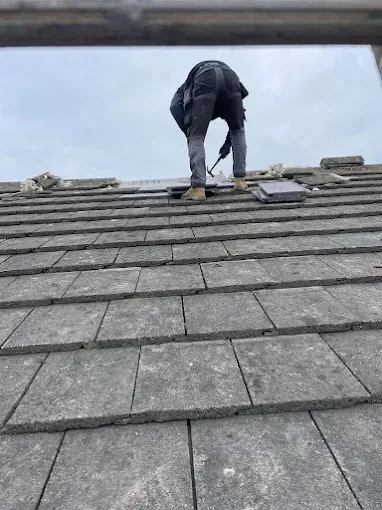
If your roof is leaking, the first thing to understand is that the water stain on your ceiling is almost never directly below the entry point. Water travels along rafters, battens, and membrane before it drips through, which means the actual cause could be metres away from where the damage appears.
That makes finding the source difficult without getting on the roof. But knowing the most common causes helps you understand what your roofer is likely to find and whether you are dealing with a quick fix or something more involved.
7 Common Causes of Roof Leaks in Edinburgh
1. Failed lead flashing
Flashing is the lead or metal that seals the joints where your roof meets walls, chimneys, dormers, and skylights. When it cracks, lifts, or pulls away from the masonry, water runs straight into the roof structure.
Chimney flashing is the most common failure point in Edinburgh. The combination of thermal movement, wind exposure, and aging mortar causes lead to fatigue and separate from the stonework over time. If you notice damp on internal walls near the chimney breast, failed flashing is the most likely cause.
Flashing failure is not always visible from ground level. A roofer needs to inspect the joints up close to confirm whether the lead has lifted, cracked, or been poorly dressed into the masonry.
2. Slipped or missing slates and tiles
A single missing slate exposes the felt or membrane underneath to direct rainfall. Edinburgh’s older properties with natural slate roofs are particularly vulnerable because the original fixing nails corrode over time, allowing slates to slip out of position gradually.
You can sometimes spot gaps from ground level, especially after a storm. But slates can also slip only a few centimetres, enough to let water in without being obvious from the pavement.
If your roof has a few slipped slates, a targeted roof repair is straightforward and catches the problem before it spreads. Leave it for months and the water damage to the timber and plaster underneath can turn a small job into a large one.
3. Cracked or deteriorating ridge tiles
Ridge tiles sit along the peak of your roof, sealed in place with mortar. Over time, that mortar cracks and washes out, leaving gaps where wind-driven rain gets in. In severe cases, the ridge tiles themselves become loose and can shift or fall.
This is one of the most common roof leak causes on Edinburgh properties because ridge mortar is fully exposed to weather from every direction. If you can see light-coloured patches or gaps along the top of your roof, the mortar is likely failing.
Ridge work is a routine repair that prevents much more expensive water damage below.
4. Blocked or damaged valleys
Valleys are the internal angles where two roof slopes meet. They channel a large volume of water and are lined with lead, fibreglass, or mortar. When a valley blocks with debris, or the lining cracks, water backs up and overflows into the roof space.
Properties with complex roof shapes, multiple extensions, or mature trees nearby are most at risk. If the leak only appears during heavy or prolonged rain, a blocked valley is a common culprit.
5. Perished underlay or membrane
Beneath your tiles or slates sits a layer of roofing felt or breathable membrane. Its job is to catch any water that gets past the outer covering and channel it down to the gutters. On older Edinburgh properties, the original bitumen felt can become brittle and tear after 30 to 40 years, at which point it stops doing its job.
When the underlay fails, water that would normally drain harmlessly away instead drips through onto the timber and ceiling below. This type of leak is often gradual, appearing as slowly growing damp patches rather than sudden drips. It usually means the roof needs more than a surface repair, often a partial or full re-roof to replace the membrane underneath.
6. Flat roof failure
Flat roofs on garages, extensions, porches, and dormers have a limited lifespan compared to pitched roofs. Older felt flat roofs are the worst offenders. They blister, crack at the seams, and eventually let water pool on the surface rather than draining.
If your leak is above a single-storey extension, a conservatory, or a garage, the flat roof section is the first place to check. Modern EPDM and GRP systems last 25 to 30 years, but older felt systems often fail within 10 to 15 years.
7. Blocked gutters causing overflow
This one surprises people, but blocked gutters are a common indirect cause of roof leaks. When gutters block, water overflows behind the fascia boards and into the roofline timber. Over time, this causes rot in the fascia, soffit, and the rafter ends, creating an entry point for water that looks like a roof leak from inside.
Properties near mature trees in areas like Morningside, Colinton, and the East Lothian coast are particularly prone to gutter blockages from leaves, moss, and debris.
How to Find Where the Leak Is Coming From
If you have an active leak, there are a few things you can check before calling a roofer:
- Check the loft space. If you can safely access it, look for daylight showing through the roof, wet patches on the underside of the felt, and water tracking along timbers. Follow the trail uphill to find the entry point.
- Look at the outside from ground level. Scan for missing or displaced slates, gaps along the ridge, and visible damage around chimneys and dormers.
- Note when the leak appears. Does it happen during any rain, or only during heavy downpours? Only when the wind comes from a certain direction? This helps narrow down the cause. Wind-driven leaks often point to flashing or ridge issues. Volume-dependent leaks suggest valleys or gutters.
- Check flat roof sections. Walk around the property and look at any flat roof areas for ponding water, blistering, or visible cracks.
If you cannot identify the source, do not guess or attempt a DIY repair on the wrong area. A professional roof inspection finds the actual entry point and prevents wasted money on fixes that do not solve the problem.
What to Do When Your Roof Is Leaking
Immediately:
- Place containers under active drips to protect floors and furniture
- Move valuables and electronics away from the affected area
- If water is near light fittings or sockets, turn off the electrics in that area at the consumer unit
- Do not go on the roof yourself, especially in wet or windy conditions
Next:
- If the leak is active and significant, call us for an emergency roofing response. We attend same-day across Edinburgh and can make the roof safe quickly.
- If the leak is slow or intermittent, book a roof inspection. We will find the source, explain the options, and quote for the repair.
- Take photos of the damage, both inside and outside if possible. These are useful if you need to make an insurance claim later.
Can a Roof Leak Be Repaired, or Does It Need Replacing?
Most roof leaks can be repaired without replacing the whole roof. Failed flashing, slipped slates, cracked ridges, and blocked valleys are all routine repairs that a competent roofer can fix in a day or less.
A full roof replacement is usually only necessary when:
- The underlay has failed across large sections
- The timber structure underneath has significant rot
- The covering material is at the end of its lifespan and deteriorating across the whole roof
- You are spending more on repeated repairs than a new roof would cost
If you are not sure which category your roof falls into, read our guide on how much a new roof costs in Edinburgh or book a free inspection.
Frequently Asked Questions
Why does my roof only leak in heavy rain?
If the leak only appears during heavy or prolonged rainfall, the most likely causes are a blocked valley, an undersized or blocked gutter, or a flat roof section that is not draining properly. Light rain may not produce enough volume to overwhelm the failing area.
Why does my roof leak when the wind blows from a certain direction?
Wind-driven rain gets forced into gaps that normal rainfall misses. The usual culprits are lifted flashing, gaps in ridge mortar, and slates that have slipped just enough to create a narrow opening. These leaks can be intermittent and difficult to locate without a professional inspection.
Can I use sealant to fix a roof leak myself?
Sealant is a temporary measure at best. Silicone or bitumen sealant applied to cracked flashing or ridge mortar may stop the leak for a few weeks or months, but it does not address the underlying failure. It also makes the eventual repair harder because the sealant needs to be removed before proper work can be done.
How quickly should I fix a roof leak?
As soon as possible. A small leak that costs a couple of hundred pounds to fix today can cause timber rot, plaster damage, electrical hazards, and mould growth that costs thousands if left for months. Water damage is cumulative and accelerates once it starts.
Will my insurance cover a roof leak?
Buildings insurance typically covers sudden damage from storms, fallen objects, and similar events. It usually does not cover gradual deterioration, wear and tear, or maintenance issues. If your leak was caused by a specific storm event, contact your insurer. We can provide a written damage report with photographs to support your claim.
Stop the Leak Before It Gets Worse
Most roof leaks in Edinburgh start small and get worse over time. The sooner you identify and fix the cause, the less damage it does and the less it costs.
At First Choice Roof Repairs, we provide free roof inspections across Edinburgh, East Lothian, the Scottish Borders, and surrounding areas. We find the source of the leak, explain what needs doing, and give you a clear quote with no pressure.
If your roof is leaking now, get in touch or call us on 07473 431365. For active leaks and storm damage, we provide same-day emergency callouts.
Need Help With Your Roof?
Get a free, no-obligation quote from our experienced team. We cover Edinburgh, the Lothians, and the Scottish Borders.
Get in Touch
Get Your Free Quote
Complete the form or give us a call. We will get back to you to arrange a free, no-obligation estimate for your roofing project.
- 07473 431365
- firstchoiceroofrepairsltd@gmail.com
- Pencraig House, Monksmuir Park, Haddington, EH41 3SB