
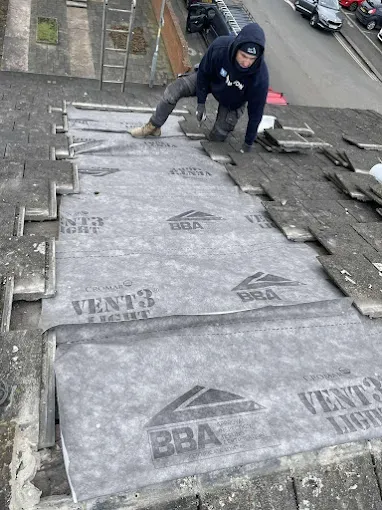
In most cases, replacing a roof in Scotland does not require planning permission. A straightforward like-for-like replacement, where you use the same material, colour, and profile as the existing roof, falls under permitted development rights and does not need a planning application.
However, there are situations where you do need permission, and a separate requirement called a building warrant that many homeowners are not aware of. Getting this wrong can mean enforcement action, having to undo completed work, or problems when you come to sell.
This guide covers the rules as they apply in Scotland, with specific guidance for Edinburgh homeowners.
Planning Permission vs Building Warrant
These are two separate things in Scotland, and confusing them is a common mistake.
Planning permission controls what you can change about the external appearance and use of a building. It is administered by your local council’s planning department (in Edinburgh, that is the City of Edinburgh Council).
A building warrant controls how the work is carried out to ensure it meets Scottish building standards for structural safety, fire resistance, insulation, and ventilation. It is also administered by the council’s building standards team, but it is a separate application and approval process.
You might need one, both, or neither depending on the work.
When You Do NOT Need Planning Permission
A new roof does not need planning permission if:
- You are replacing the existing covering with the same material, colour, and profile (like-for-like)
- You are not altering the shape, height, or profile of the roofline
- You are not adding new features such as roof windows, dormers, or solar panels
- Your property is not in a conservation area
- Your property is not a listed building
This covers the majority of domestic re-roofs in Scotland. If your 1970s semi-detached has concrete tiles and you are replacing them with new concrete tiles of the same type, you do not need planning permission.
When You DO Need Planning Permission
Planning permission is likely required if you want to:
- Change the roofing material to something visibly different (for example, switching from slate to concrete tiles or vice versa)
- Alter the roofline profile by raising or lowering the ridge, changing the pitch, or adding a new section
- Add dormers, roof windows, or skylights that alter the external appearance of the property
- Install solar panels on a listed building or in certain conservation areas (solar panels on most standard properties fall under permitted development, but there are exceptions)
- Convert a loft where the work involves external roof alterations
If your property is in a conservation area, even a like-for-like replacement may need planning consent if the council considers the work to affect the character of the area. In practice, most Edinburgh conservation area re-roofs using matching slate are approved, but you should check with the council before starting work.
If your property is a listed building (Category A, B, or C), you need listed building consent for any work that affects its character, which includes roof work. This is a separate application from standard planning permission and is assessed by Historic Environment Scotland for Category A buildings.
Building Warrants in Scotland
This is where many homeowners get caught out. Even when planning permission is not required, a building warrant may be.
Under the Building (Scotland) Act 2003, a building warrant is required for most building work that involves structural alteration or that must comply with building standards. For roofing, the key trigger is:
If you are replacing more than 25% of the roof covering, a building warrant is normally required.
This applies even for a like-for-like material replacement. The logic is that once you strip a significant portion of the roof, the council needs to verify that the rebuilt structure meets current standards for:
- Structural integrity of the timber and fixings
- Thermal insulation to current energy efficiency standards (Section 6 of the Scottish building standards)
- Ventilation to prevent condensation in the roof space
- Fire resistance where required
What the building warrant process involves
- Application submitted to your local council building standards department, including plans and a specification of the work
- Approval granted (typically 2 to 6 weeks, though Edinburgh can be slower during busy periods)
- Work proceeds in accordance with the approved plans
- Completion certificate issued by the council after a final inspection confirms the work meets standards
Your roofer should handle the warrant application as part of the project. At First Choice Roof Repairs, we prepare the application, manage the process, and arrange the completion inspection. You should not need to deal with the council directly.
What happens if you skip the building warrant
If you carry out work that requires a warrant without getting one, the council can issue an enforcement notice requiring you to either obtain retrospective approval (which is not guaranteed) or undo the work. More commonly, the problem surfaces when you sell the property. Your solicitor or the buyer’s surveyor will check the building warrant history, and missing warrants cause delays, price reductions, or collapsed sales.
Conservation Areas in Edinburgh
Edinburgh has over 50 conservation areas covering large parts of the city, including the New Town, Old Town, Stockbridge, Morningside, Marchmont, Bruntsfield, Corstorphine, and many more. If your property falls within one, the rules around roof work are stricter.
In a conservation area:
- Material choice may be restricted. The council can require you to use natural slate rather than concrete tiles, or to match the colour and profile of the original covering. This is to preserve the visual character of the streetscape.
- Planning permission may be needed even for a re-roof if the council considers the change to affect the character of the area. In practice, replacing slate with matching slate is usually fine, but switching materials (concrete to slate or vice versa) will likely trigger a requirement.
- Demolition consent is needed before removing certain structures, though this rarely applies to roof coverings on residential properties.
You can check whether your property is in a conservation area using the City of Edinburgh Council’s conservation area map. If you are in East Lothian, check with East Lothian Council. For properties in the Scottish Borders, check with Scottish Borders Council.
Listed Buildings
Listed buildings have the tightest restrictions. Scotland uses a three-tier listing system:
- Category A: buildings of national or international importance
- Category B: buildings of regional or more than local importance
- Category C: buildings of local importance
For any listed building, you need listed building consent before carrying out work that affects the character of the building. Roof work almost always falls into this category. The consent process involves a formal application to the council, and for Category A buildings, consultation with Historic Environment Scotland.
The key requirements for listed building roof work:
- Matching materials are essential. You will typically need to use the same type and source of slate, or demonstrate that the replacement is an acceptable match.
- Traditional methods may be required. Lime mortar rather than cement for ridge and verge bedding, hand-dressed lead flashing, and traditional fixing methods may all be specified.
- Advance approval is mandatory. Starting work without listed building consent is a criminal offence under the Planning (Listed Buildings and Conservation Areas) (Scotland) Act 1997.
If your property is listed, we can advise on what is required and have experience working within these constraints on Edinburgh properties. The process takes longer than a standard re-roof, but getting it right protects both the building and your legal position.
Roof Repairs vs Full Replacement
The rules above apply primarily to full or substantial roof replacements. Minor roof repairs, such as replacing a few slipped slates, repointing ridge tiles, or renewing a section of lead flashing, do not normally require planning permission or a building warrant.
The threshold is the 25% rule for building warrants. If the repair involves less than 25% of the roof covering, a warrant is not normally needed. For planning permission, minor like-for-like repairs fall comfortably within permitted development even in conservation areas.
However, if you are in a listed building, even minor repairs may require listed building consent if they affect the character of the building. Check with the council if in doubt.
Frequently Asked Questions
Do I need a building warrant to replace my roof in Scotland?
If you are replacing more than 25% of the roof covering, a building warrant is normally required. This applies even if you are using the same material. The warrant ensures the work meets current Scottish building standards for structure, insulation, and ventilation. Your roofer should handle the application.
Can I change my roof material without planning permission?
On a standard property outside a conservation area, changing the material (for example, from concrete tiles to slate) usually falls under permitted development and does not need planning permission, provided you do not alter the roofline. In a conservation area or on a listed building, changing the material will almost certainly require planning consent or listed building consent.
How long does a building warrant take in Edinburgh?
The City of Edinburgh Council aims to process building warrant applications within 20 working days for straightforward domestic work. In practice, it can take 4 to 8 weeks depending on the council’s workload and whether they request additional information. We factor this lead time into project planning.
What happens if my property is in a conservation area and I need a new roof?
You should check with the council before starting work. In most cases, a like-for-like replacement using matching materials will be acceptable, but the council may want to approve the specification in advance. If you want to change materials, a planning application is likely needed. We can advise on what your specific property requires during a free roof survey.
Do solar panels on a roof need planning permission in Scotland?
For most standard residential properties, solar panels fall under permitted development and do not need planning permission, provided they do not protrude more than 200mm from the roof surface and are not higher than the highest part of the roof. Exceptions apply to listed buildings, some conservation areas, and properties where the panels would face a road. Check the Scottish Government planning guidance for the full permitted development rules.
Get the Right Advice Before You Start
Planning rules and building warrants can seem complicated, but your roofer should be navigating them for you. At First Choice Roof Repairs, we advise on what permissions are needed during your free survey, handle building warrant applications, and work within conservation area and listed building requirements as part of the project.
If you are planning a new roof and want to understand what is involved, read our guide on what a new roof costs in Edinburgh. You can also browse our project gallery to see recent work, or get in touch for a free survey. Call us on 07473 431365.
Need Help With Your Roof?
Get a free, no-obligation quote from our experienced team. We cover Edinburgh, the Lothians, and the Scottish Borders.
Get in Touch
Get Your Free Quote
Complete the form or give us a call. We will get back to you to arrange a free, no-obligation estimate for your roofing project.
- 07473 431365
- firstchoiceroofrepairsltd@gmail.com
- Pencraig House, Monksmuir Park, Haddington, EH41 3SB